We are pleased to announce our call for papers, posters, panels, and workshops for the Music Encoding Conference 2027.
The Music Encoding Conference brings together members from music encoding, analysis, performance, and research communities, including musicologists, theorists, librarians, technologists, music scholars, teachers, and students, providing an opportunity for all participants to learn from and engage with each other.
This year, we will host lectures, panels, posters, and workshops and tutorials, as well as a showcase where developers can demonstrate software tools and platforms.
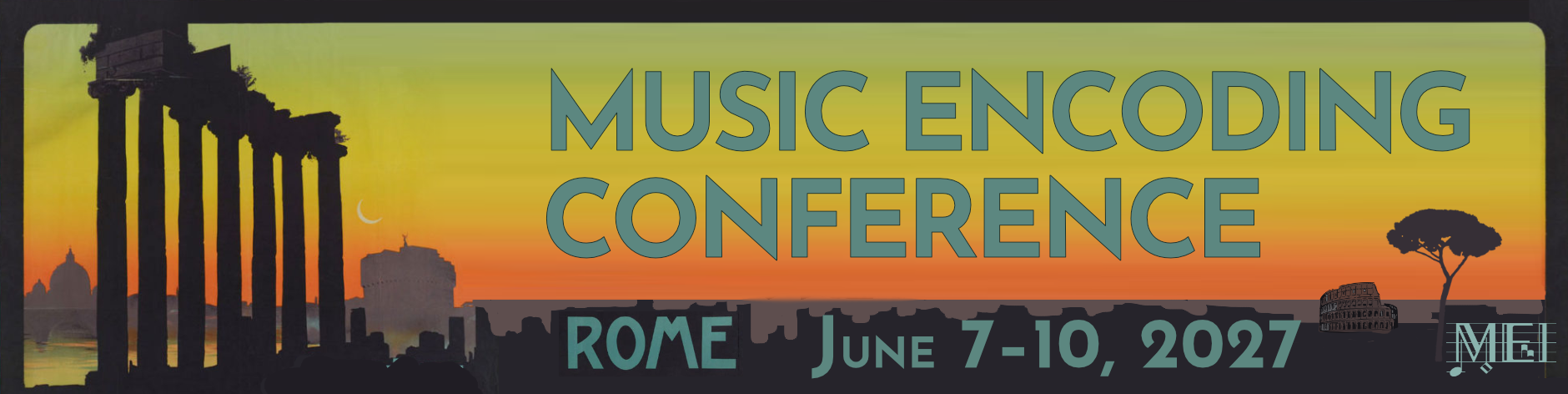
The conference will be held 7–10 June 2027 at the German Historical Institute and Pontifical Institute of Sacred Music, Rome, Italy on behalf of the Music Encoding Initiative community.
| Proposal Deadline | Friday, December 18, 2026. Attention: The deadline will not be extended. |
| Notification of Acceptance | Monday, February 8, 2027 |
| Registration Deadline (for authors) | Monday, April 5, 2027 |
| Last changes to abstracts for publication | Monday, May 3, 2027 |
| Conference Dates | June 7–10, 2027 |
For further questions, please e-mail conference2027@music-encoding.org
The Music Encoding Conference provides a forum where researchers and practitioners from varied fields can meet and share new research built on digital music editions and, especially, research into music encoding itself. The Conference celebrates a multidisciplinary program, combining the latest advances from established music encodings, novel technical proposals and encoding extensions, and the presentation and evaluation of new practical applications of music encoding (e.g. in academic study, libraries, editions, pedagogy).
When using and manipulating music in the digital domain, the properties and behaviours of its encoding are of fundamental importance. This applies equally for musicological study, music theory, production of digital editions, composition, performance, teaching and learning, cataloguing, symbolic music information retrieval and recommendation, or more general electronic presentation of musical material and associated narratives. It also applies for a wide range of musics, including those that are not conventionally notated at all. The study of music encoding and its applications is therefore a critical foundation for the use of music information by scholars, librarians, publishers, and the wider music industry.
We welcome contributions from all those working on music encoding, but also those whose research builds on digital music resources or corpora. Newcomers are encouraged to submit to the main program, demonstrating with articulations of the potential for music encoding in their work, and highlighting strengths and weaknesses of existing approaches within this context. We always seek to broaden the scope of musical repertories considered, and to provide a welcoming, inclusive community for all who are interested in this work. The Music Encoding Conference is supported and organised by the Music Encoding Initiative, which will hold its annual community meeting on Thursday, 10 June.
The main academic conference is preceded by pre-conference workshops and tutorials, which provide an opportunity to engage with the tools and good practices developed within the community, and this will be further reinforced by a showcase during the conference, where these tools can also be demonstrated.
Following a formal program, unconference sessions will be held on 10 June 2027, designed to foster collaboration in the community through the meeting of Interest Groups, and open participation in discussions on hot topics that emerge during the conference. Spaces for these meetings have been generously provided by the German Historical Institute. As part of the conference, we would like to extend an invitation to attendees who may wish to organize additional meetings (e.g. project meetings) or other collaborative sessions in conjunction with the event. Availability of space for meetings during or immediately before or after the conference can be checked upon request. Please get in touch with conference organizers if you need to reserve these spaces.
The conference welcomes contributions from all those who are developing or using music encodings in their work and research.
Topics around music encoding include, but are not limited to:
Topics concerned with use of music encoding might situate them in:
| Category | Word Count | Presentation Time |
|---|---|---|
| Long papers | 1000-1500 words | 20 min presentation + 10 min for discussion |
| Short papers | 500-1000 words | 10 min presentation + 5 min for discussion |
| Panels | 1500-2000 words | 90 min total |
| Posters | 500-1000 words | N/A |
| Showcase demonstrations | 500-1000 words | N/A |
| Half- or full-day workshops | 1000-1500 words | Half day (3-4 hours) or full day (6-8 hours) |
→ Submit here(more details below)
The Program Committee for the Music Encoding Conference 2027 will accept proposals for papers, posters, panels, showcase demonstrations and workshops in the form of extended abstracts. All submissions will be double-blind peer-reviewed by multiple members of the committee before a decision is made on acceptance. After the review process, authors of accepted submissions will have the opportunity to make non-substantive revisions before the conference, to address minor corrections or clarifications suggested during the review process.
Please also refer to our statement on
the use of generative AI for submissions and reviews.
Accepted abstracts will be
published as part of the conference program and in a book of abstracts after the
conference.
Authors are invited to upload their anonymized submissions for review to our Conftool website: https://www.conftool.net/mec2027/
The deadline for all submissions is 18 December 2026 (see IMPORTANT DATES above, and note that there will no extension of the deadline). When you upload into ConfTool, you will be asked for Title, Author information and the PDF of your submission. In addition, you will need to supply a short summary abstract and up to five keywords – these will be used for review assignment, but may also appear on the conference programme and website. Since review will be anonymous, please ensure that all identifying information is removed from your PDF before submission.
Please use our template at
https://tinyurl.com/MEC2026-Template
for your PDF proposals. Word counts apply to the
text of the proposal, excluding titles, keywords and references.
Long papers are expected to present overviews or specific aspects of ongoing or completed projects, detailed case-studies or elaborated perspectives on best practices in the field, or provide in-depth reports on topics relevant to the conference. Speakers will be given 30 minutes: 20 minutes for their presentation, and 10 minutes for discussion.
Short papers are suitable for introducing tools, new ideas, and experimental topics. Speakers will be given 15 minutes: 10 minutes for presentation, 5 minutes for discussion.
Panels are suited to coordinated approaches or discussions relating to a single theme, or round-table discussions. Particularly welcome are those with interactive elements, such as Q&A sessions or community consultation. Submissions should describe the topic and nature of the panel, along with its format, including titles and short abstracts for any presentations that will form part of the session. It should be clear from the text how any presentations are connected, and the way these will be integrated into the discussion.
Themed sessions (independent papers relating to a single topic or project) will not be considered; instead these should be submitted as separate papers. Panel sessions will be given 90 minutes, which can be used flexibly.
Posters are expected to report on early-stage work, introduce new work, projects, or software, or present experimental ideas for community feedback. Poster presenters will have the chance to engage with interested parties more about their project during the poster exhibition, where the audience can browse freely.
Poster Size: maximum DIN A0 (841 x 1189 mm or 33.1 x 46.8 inches), portrait format
We will host a showcase session, giving the opportunity to show tools and resources in an interactive and engaging way. Presenters will be given small tables to stand demos on, and poster boards for any written information.
Poster Size: maximum DIN A0 (841 x 1189 mm or 33.1 x 46.8 inches), portrait format
These can be tutorials, explaining key concepts and tools, or interactive workshops, engaging participants as contributors. Proposals must also include: